CHARGEBEE · DESIGN OPS · 2022 – 2023
A Human-Centered Onboarding System at Scale
A design-led reimagining of how product designers join, integrate, and grow at Chargebee — focused on belonging, confidence, and early contribution.
Role
Product Design Manager
Timeline
6 months
Team
Design · HR · Product Ops
Platform
Internal · Notion · Slack
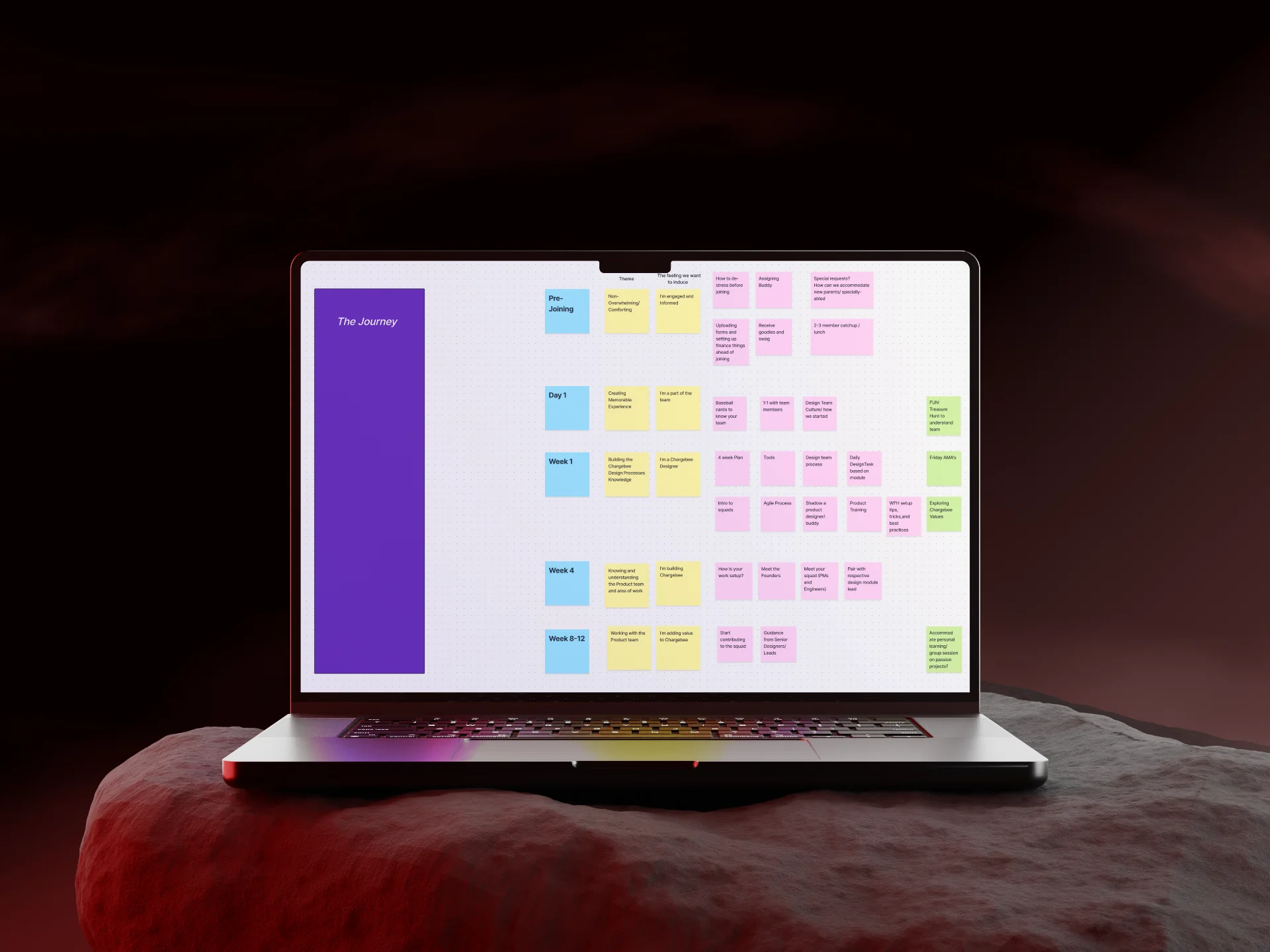
Onboarding as experience, not process
As Chargebee scaled, the Product Design team grew across products, squads, and locations. Designers joined excited but often felt overwhelmed, disconnected, or unsure where to start. The existing experience was well-intentioned but fragmented — optimised for information delivery rather than emotional safety and confidence building.
- Pre-joining uncertainty
- Day 1 overload
- Lack of clarity on expectations
- Tooling and design system confusion
- Hesitation to ask for help
The challenge was not to add more documentation. It was to design an onboarding system that helped designers feel welcomed, supported, and capable.
What we heard from recently onboarded designers
I partnered with Sahib to deeply understand the lived experience of new designers — interviews, journey mapping from pre-joining to Week 12, and an audit of every existing touchpoint.
Insight 01
Human contact mattered more than content
Designers trusted peers and buddies more than managers for everyday questions.
Insight 02
Pre-joining communication set the emotional tone
A single personal message from a manager had more impact than any HR checklist.
Insight 03
Learning by doing built confidence faster
Designers felt productive when given small, real tasks early.
Insight 04
Design system literacy was foundational
Without guidance, new hires lost days figuring out tools and patterns.
Insight 05
Some designers joined exhausted
Many joined immediately after leaving a previous job and needed a softer landing.
These insights reframed the problem from onboarding as process to onboarding as experience.
Welcome → Learn → Do → Belong
We designed an end-to-end onboarding system grounded in a simple narrative arc, with three guiding principles: build belonging early, build confidence through structure, build capability through contribution.
01
Welcome
02
Learn
03
Do
04
Belong
Feel expected, not processed
- Personal outreach from managers instead of generic HR messages
- Slack introductions and team visibility before joining
- Optional invites to team lunches
- Clear pre-boarding checklist to remove admin burden
- Flexible onboarding for fatigued joiners
From information dump to human-first welcome
- Warm team introductions
- Buddy pairing
- Peer-led product walkthroughs
- Light hands-on tasks
- Shared lunch
- End-of-day check-in
Day 1 no longer felt overwhelming. It felt intentional.
Guided learning with human touchpoints
- Live design system walkthroughs
- Clear SME ownership for modules
- Reduced and intentional learning content
- Micro-tasks that enabled contribution by Day 3 or 4
- Regular buddy check-ins
The biggest shift was moving from watch first to do first.
From learning to contribution to belonging
Weeks 2–4. Paired design sessions, small but meaningful tasks, shadowing sprint rituals, early collaboration with PMs and engineers, structured one-on-ones.
Weeks 8–12. Designers owned a small problem space, participated in reviews, understood tools and systems, and collaborated confidently across squads. This was the moment they transitioned from new joiner to Chargebee Designer.
The Buddy Program
The buddy program became the emotional core of onboarding — designers shared concerns they hesitated to raise with managers, buddies helped navigate culture (not just tools), it reduced repetitive questions for managers, and it created continuity across the design org.
A meaningful human and operational impact
Onboarding shifted from a checklist to a lived experience.
What I'd carry into any people system
- Belonging is a prerequisite for performance
- Confidence grows faster through doing than watching
- Peer support scales better than manager dependency
- Onboarding must adapt to human context, not just timelines
- Systems need ownership to remain alive
Let's
Talk
I'm most energized by work where I can dig into complex problems, collaborate with smart people, and ship things that genuinely improve someone's day.

Sreevatsan
Let's talk about AI, Design and any other interesting conversations about hard design problems.